
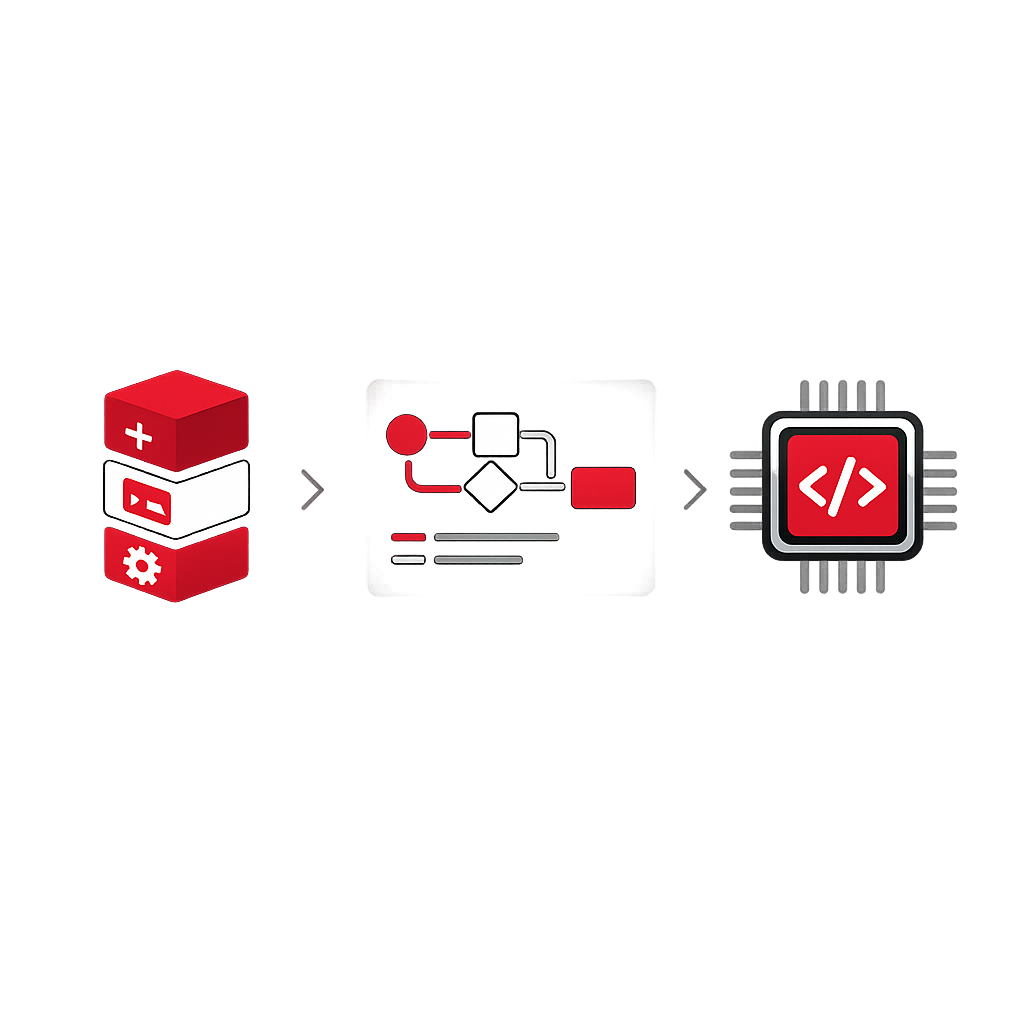
“No-code builds fast, low-code extends control, AI coding accelerates both. Choose by risk, skill, and scale.”
No-code, low-code, and AI coding are three approaches that help individuals and organizations create digital solutions faster than with traditional software development alone. They do not replace every engineering practice, but they change how applications, automations, workflows, and prototypes can be designed, tested, and delivered.
The main difference between them is the level of technical skill required, the flexibility offered, and the role of automation in creating the final solution. Understanding these distinctions helps teams choose the right approach for speed, cost, governance, and long-term maintainability.
What no-code stands for
No-code refers to platforms that allow users to build applications, websites, workflows, dashboards, or automations without writing code. The experience is usually based on visual interfaces, drag-and-drop components, templates, and configuration menus.
This approach is designed for business users, operational teams, and subject matter experts who understand the process or problem to solve but do not necessarily have software development skills. No-code is often used for:
- Simple internal tools
- Approval workflows
- Data collection forms
- Basic customer portals
- Rapid process digitization
The main strength of no-code is speed. A team can move from idea to usable solution quickly. The main limitation is that customization and complex logic can become difficult when the use case grows beyond what the platform was designed to support.
What low-code stands for
Low-code refers to platforms that use visual development tools but still allow some coding for advanced logic, integrations, extensions, and customization. It sits between no-code simplicity and full custom development.
Low-code is generally intended for developers, technical analysts, and advanced business technologists who want to accelerate delivery without losing too much control. It is commonly used for:
- Business applications with custom workflows
- Integration with existing systems
- Applications that need role-based security
- Scalable internal platforms
- Solutions that require custom business rules
The main strength of low-code is balance. It improves productivity while keeping room for deeper technical adaptation. The main challenge is governance: if many teams build quickly without shared standards, the result can become difficult to support and evolve.
What AI coding stands for
AI coding refers to the use of artificial intelligence to assist or automate parts of software creation. Instead of relying only on visual builders or manual coding, users describe what they want, and the system can suggest, generate, explain, refactor, or test code and logic.
AI coding can support both technical and non-technical users depending on the tool. Common use cases include:
- Generating code from natural language instructions
- Creating formulas, scripts, or queries
- Accelerating debugging and documentation
- Producing prototypes faster
- Helping users understand unfamiliar languages or frameworks
The key advantage of AI coding is acceleration. It reduces effort in repetitive tasks and lowers the barrier to starting technical work. The main risk is overtrust: generated outputs may look correct while containing errors, security issues, or poor design choices if not reviewed carefully.
No-code vs low-code vs AI coding
These three approaches are often compared, but in practice they can complement each other.
- No-code: best when speed and accessibility matter most
- Low-code: best when visual development must be combined with technical flexibility
- AI coding: best when creation, adaptation, or troubleshooting needs to be accelerated through intelligent assistance
A simple way to understand them is:
- No-code minimizes or removes manual coding
- Low-code reduces the amount of coding needed
- AI coding helps produce or improve code and logic automatically
How to choose the right approach
The right choice depends on the nature of the problem being solved.
Choose no-code when
- The process is clear and relatively standard
- The solution must be delivered very quickly
- The users building it are not developers
- Customization needs are limited
Choose low-code when
- The application needs integration with multiple systems
- Business rules are more complex
- Security, scale, and maintainability matter more
- Technical teams need to extend the platform
Choose AI coding when
- Teams want to speed up development tasks
- Users need help generating technical assets from intent
- Prototyping and experimentation are frequent
- There is enough review capability to validate outputs
Benefits for organizations
When used correctly, these approaches can improve delivery in several ways:
- Faster implementation of ideas
- Reduced dependency on scarce technical resources
- Better collaboration between business and technical teams
- Shorter feedback loops
- More opportunities for experimentation and continuous improvement
They are especially valuable when organizations need to digitize processes, automate repetitive work, improve responsiveness, or support innovation without waiting for long development cycles.
Risks to manage
Speed can create hidden complexity if governance is weak. Common risks include:
- Solutions built without architecture standards
- Data quality and access control issues
- Applications that are difficult to maintain over time
- Vendor lock-in
- Generated logic that is not fully understood by its users
To limit these risks, organizations should define clear ownership, review practices, security rules, lifecycle management, and training expectations.
A practical decision framework
Before selecting an approach, ask these questions:
- How complex is the process or application?
- Who will build and maintain it?
- How critical is reliability and compliance?
- What level of customization is needed?
- How fast must the first version be delivered?
- How likely is the solution to scale or evolve?
If the answer points to simplicity and speed, no-code is often enough. If it points to controlled flexibility, low-code is usually the better fit. If it points to productivity gains across technical work, AI coding can add strong value, especially when combined with either of the other two approaches.
Key takeaway
No-code, low-code, and AI coding are not only tools or trends. They represent different ways to transform ideas into working solutions with varying levels of abstraction, control, and automation. The best choice is not the most advanced one, but the one that matches the real need, the people involved, and the level of risk the organization is prepared to manage.