
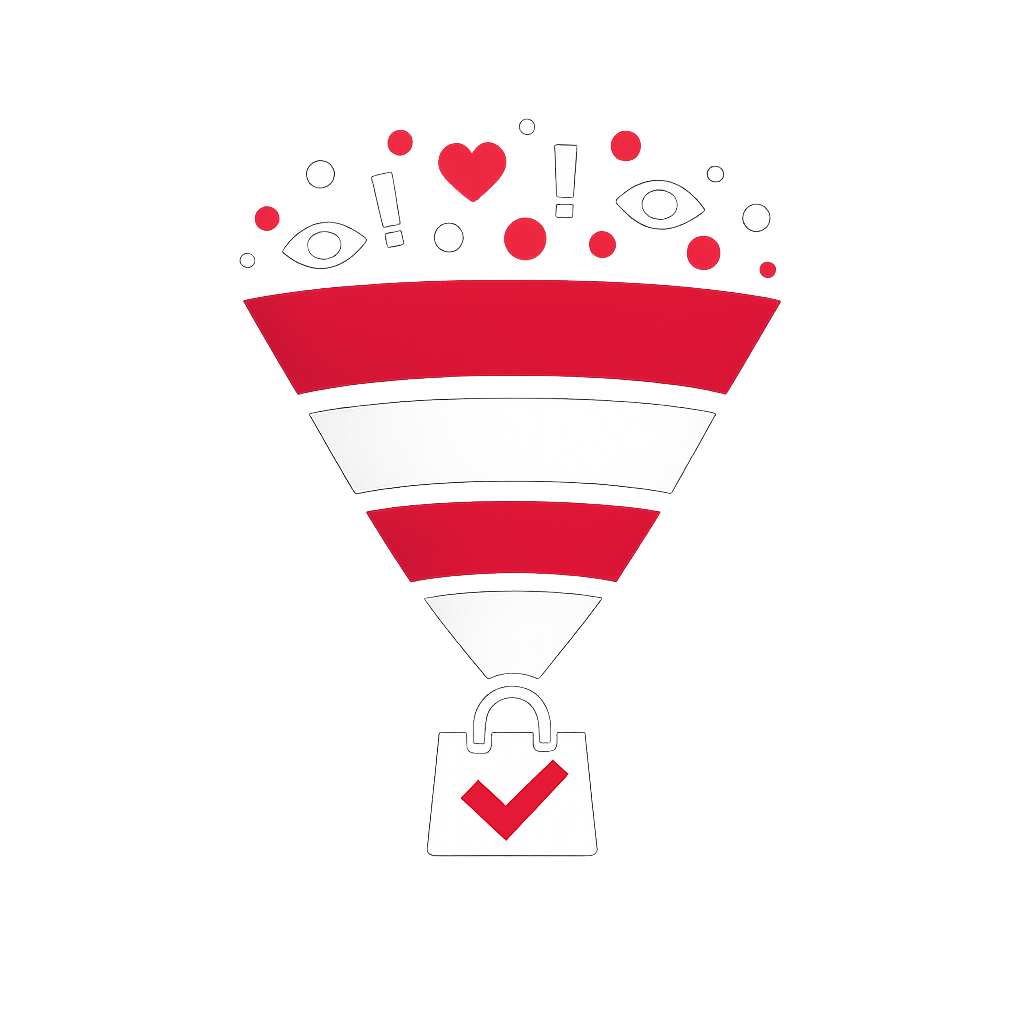
“Turn attention into trust, trust into action, and action into loyalty with a clear path from first contact to purchase.”
The marketing and sales funnel is a model used to understand how people move from first discovering an offer to becoming customers, and in some cases, loyal advocates. It helps organizations structure their efforts by recognizing that not every person is ready to buy immediately. Instead, people usually progress through stages of awareness, interest, evaluation, decision, and action.
This framework stands for a progressive journey. At the top, a large number of people may encounter a brand, product, service, or idea. As the journey continues, fewer people remain engaged, but those who do are usually more qualified, more interested, and closer to making a decision. The funnel shape illustrates this reduction from a broad audience to a narrower group of buyers.
The value of this model is not only in describing buyer behavior, but also in helping teams align their actions. Early stages require visibility, clarity, and relevance. Middle stages require education, proof, and trust. Final stages require reassurance, ease of purchase, and a strong value proposition. When each step is understood, organizations can identify where prospects are lost and where improvements can create better results.
A common interpretation of the funnel includes several key stages:
- Awareness: people first discover a need, a problem, or a possible solution.
- Interest: they begin exploring available options and seek useful information.
- Consideration: they compare alternatives, evaluate benefits, and review credibility.
- Intent: signs appear that they may be ready to act, such as requesting details or engaging more deeply.
- Decision: they choose whether to proceed.
- Action: the purchase, subscription, registration, or other desired commitment is completed.
In practice, this journey is not always linear. People may move forward, pause, go backward, or abandon the process entirely. A potential buyer might become aware of a solution today, research options next month, and decide much later. Because of this, the funnel should be treated as a useful guide rather than a rigid rule.
One of the main strengths of the funnel is that it encourages better diagnosis of performance. If many people discover an offer but very few engage further, the issue may be weak messaging or poor targeting. If interest is strong but decisions remain low, the problem may be trust, pricing, timing, usability, or lack of evidence. This way of thinking supports continuous improvement and more informed decision-making.
The model is also useful for collaboration between teams. When different functions share a common view of progression from initial contact to conversion, they can define clearer responsibilities, improve handoffs, and measure outcomes more effectively. This reduces friction, especially where multiple stakeholders contribute to attracting, informing, and converting potential customers.
To use the funnel effectively, organizations should focus on a few practical principles:
- Understand audience needs: know the questions, concerns, and expectations that exist at each stage.
- Match content to maturity: introductory information works early, while detailed proof and comparisons are more useful later.
- Remove friction: simplify forms, reduce unnecessary steps, and make actions easy to complete.
- Build trust: use testimonials, case studies, transparent information, and consistent communication.
- Measure progression: track where people advance, where they hesitate, and where they exit.
- Refine continuously: improve based on evidence rather than assumptions.
The funnel remains a popular concept because it translates a complex human decision process into a manageable framework. While modern customer journeys may involve multiple channels, repeated interactions, and non-linear behavior, the core idea remains valuable: broad attention must be converted into focused engagement, then into meaningful action.
Used wisely, the marketing and sales funnel is more than a reporting tool. It is a way to design better experiences, improve communication, identify weak points in conversion, and support growth through a clearer understanding of how decisions are made.
References
Wikipedia – Purchase funnel
Investopedia – Sales Funnel
HubSpot – What Is a Sales Funnel?