
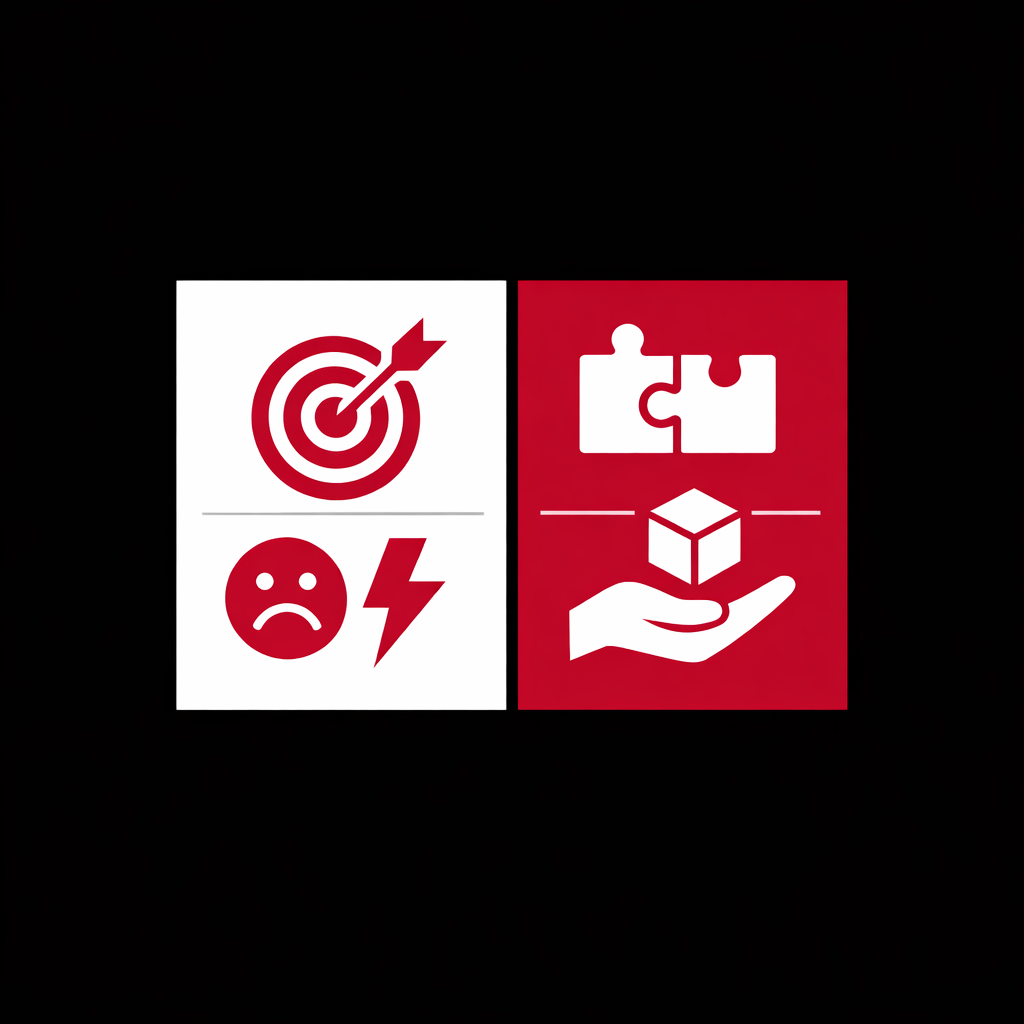
“Clarify what customers need, what frustrates them, and how your offer helps—so value becomes concrete.”
The Value Proposition Canvas is a practical framework used to better understand how an offer connects with customer expectations. It helps structure thinking around two essential dimensions: the customer profile and the value map. Its purpose is to make sure a product, service, or initiative is not defined only by internal assumptions, but by the real problems people want solved, the benefits they expect, and the outcomes they are trying to achieve.
This approach is especially useful when teams struggle with vague positioning, weak adoption, unclear customer needs, or offers that seem technically sound but fail to generate interest. By making customer intent and offer design visible in a simple format, it becomes easier to align priorities, improve communication, and identify where an offer delivers meaningful value.
What it stands for
The Value Proposition Canvas is a model designed to describe the fit between what customers care about and what an organization provides. It breaks the discussion into two connected parts:
- Customer Profile: what customers are trying to get done, what difficulties they face, and what gains they seek.
- Value Map: how a product or service creates value through features, pain relievers, and gain creators.
The strength of the canvas lies in the relationship between these two sides. It encourages teams to move beyond generic statements such as “high quality” or “innovative solution” and instead explain precisely how an offer reduces specific frustrations or enables desired outcomes.
The customer profile
The customer profile captures three elements:
- Customer jobs: the tasks, needs, or problems customers are trying to address. These may be functional, social, or emotional.
- Pains: obstacles, risks, frustrations, or negative consequences linked to those jobs.
- Gains: the positive outcomes, advantages, or improvements customers hope to achieve.
Customer jobs are not limited to buying or using a product. They can include making decisions, reducing uncertainty, improving status, saving time, or avoiding mistakes. Pains may involve complexity, cost, poor usability, delays, or fear of failure. Gains may include convenience, speed, confidence, recognition, growth, or better results.
The value map
The value map describes how an offer responds to the customer profile through three components:
- Products and services: what is offered to help the customer get a job done.
- Pain relievers: how the offer reduces or removes frustrations, barriers, or risks.
- Gain creators: how the offer enables benefits, improvements, or desirable outcomes.
This side of the canvas prevents teams from listing features without purpose. Every element should be linked to a customer reality. A useful offer is not only something that exists; it is something that solves, simplifies, reassures, accelerates, or improves.
Why it matters
Many offers fail not because they lack capability, but because they lack relevance. Teams may invest heavily in functionality, process, or communication without verifying whether the target audience truly values those elements. The Value Proposition Canvas reduces this risk by forcing clearer reasoning:
- What is the customer really trying to achieve?
- What makes that difficult today?
- What would make the outcome better?
- How exactly does the offer respond?
When used well, the framework supports prioritization, improves stakeholder alignment, sharpens messaging, and increases the chance that an offer will resonate with its intended audience.
How to use it effectively
- Select a specific customer segment
The canvas works best when focused on a clearly defined audience. Trying to describe everyone at once usually produces vague conclusions. - List customer jobs
Identify what this audience is trying to accomplish in practical, emotional, and social terms. - Identify pains
Clarify what creates friction, delay, cost, anxiety, or dissatisfaction. - Identify gains
Define the outcomes customers want, expect, or would appreciate. - Map products and services
Describe the relevant parts of the offer without trying to include everything. - Define pain relievers and gain creators
Explain how the offer reduces key pains and creates meaningful gains. - Assess fit
Compare both sides and check whether the offer addresses what matters most. - Validate with evidence
Replace assumptions with interviews, observation, testing, and feedback.
Common mistakes
- Being too generic: phrases like “better experience” or “easy to use” are too broad unless linked to a specific pain or gain.
- Focusing only on features: customers value outcomes more than internal descriptions of capability.
- Trying to solve everything: strong value propositions usually concentrate on the most important jobs, pains, and gains.
- Skipping validation: a well-filled canvas is still only a hypothesis until tested with real users or customers.
- Confusing internal priorities with customer priorities: what is easy to build is not always what matters most.
Example of practical application
Imagine a digital service intended to help teams coordinate work. A weak value proposition might simply say that the platform is modern, secure, and collaborative. A stronger value proposition, developed through the canvas, would identify concrete customer jobs such as tracking tasks, reducing confusion, and reporting progress. It would then highlight pains such as scattered information, missed deadlines, and unclear responsibilities. Gains might include visibility, faster coordination, and greater confidence in delivery. The offer could then be framed around shared workspaces, automated reminders, and clear dashboards because these directly relieve pain and create gains.
This shift from broad description to precise relevance is where the framework provides real value.
Benefits of using the canvas
- Creates a shared language around customer needs
- Helps refine products, services, and messaging
- Improves focus on what matters most
- Supports better decision-making and prioritization
- Encourages evidence-based design rather than assumption-driven planning
References