
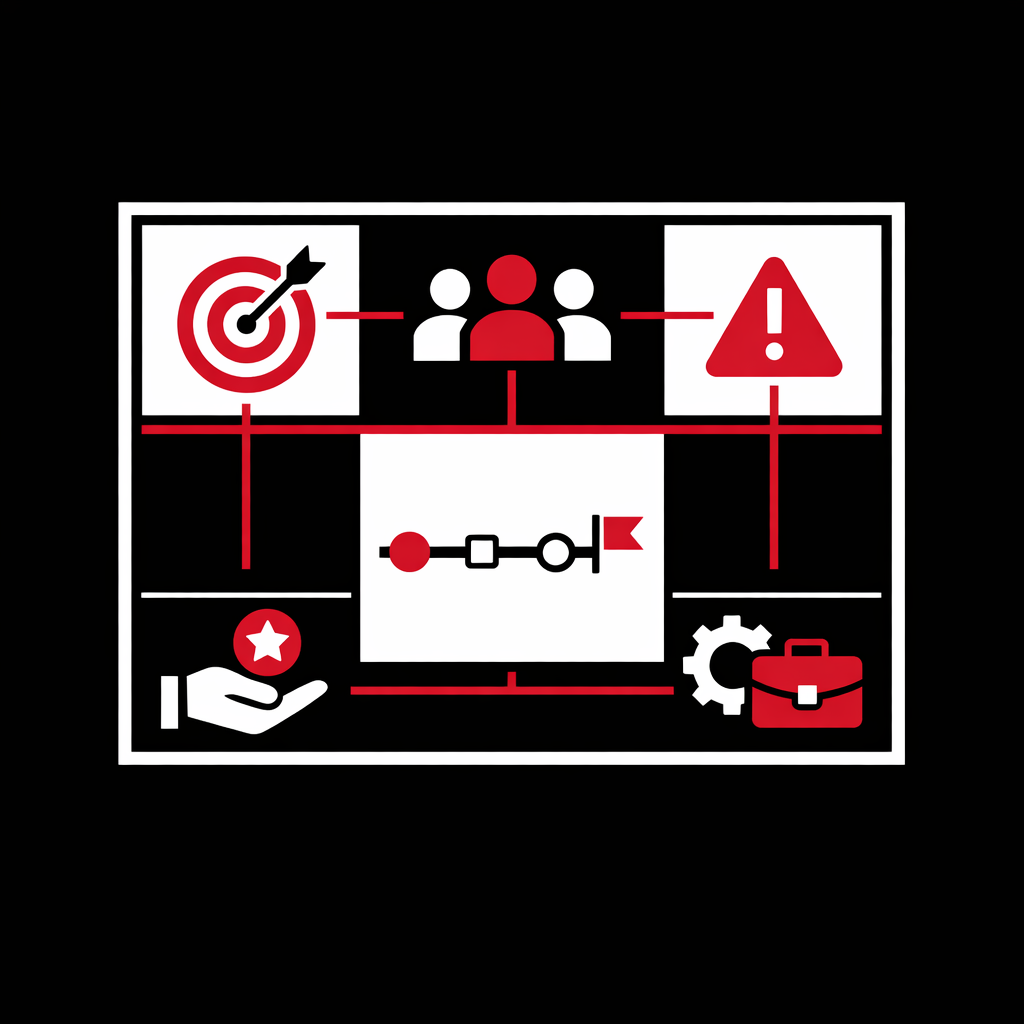
“Visualize scope, stakeholders, risks, and value on one page to align teams faster and guide better decisions.”
The Project Model Canvas is a visual framework used to structure a project on a single page. It helps transform an idea into a shared and actionable representation by bringing together the essential elements needed to frame, discuss, and guide the initiative. Instead of starting with long documentation, it encourages teams and sponsors to clarify purpose, expected outcomes, constraints, participants, and major uncertainties in a simple and collaborative format.
This approach stands for a practical way to design and communicate a project. It makes the project easier to understand by showing, in one consolidated view, why the initiative exists, what must be delivered, who is involved, what assumptions matter, and what could affect success. The canvas becomes a discussion tool as much as a planning tool, helping people align early before execution becomes complex and costly to adjust.
Its strength comes from simplicity. A single-page model supports quick workshops, better conversations, and clearer prioritization. When teams can see the full picture at once, they are more likely to identify gaps, contradictions, dependencies, and risks. This improves shared understanding across sponsors, contributors, and decision-makers.
What it typically includes
While versions can vary, a Project Model Canvas usually covers core building blocks such as:
- Purpose: the reason the initiative exists and the problem or opportunity it addresses.
- Objectives: the outcomes expected and the measurable results sought.
- Deliverables: the tangible outputs that will be produced.
- Stakeholders: the people or groups impacted by the initiative or involved in decisions.
- Resources: the capabilities, budget, tools, and time required.
- Constraints: the limits that shape the initiative, such as deadlines, compliance, or budget.
- Assumptions: the conditions believed to be true at the start.
- Risks: the events or uncertainties that may create delay, cost increase, quality issues, or reduced value.
By organizing these elements visually, the canvas helps teams avoid treating planning as a purely administrative task. It becomes a way to think critically before significant effort is committed.
Why it is useful
Many initiatives fail not because of poor effort, but because the initial framing was incomplete or misunderstood. The Project Model Canvas helps address this challenge by making the foundation explicit from the beginning. It supports:
- Faster alignment between sponsors and delivery teams
- Clearer communication across functions
- Earlier identification of uncertainties and dependencies
- Better prioritization of scope and expected value
- Simpler onboarding of new contributors
- More effective decision-making during change
Because it is concise, it is also easier to review and update than a large project charter. This makes it particularly valuable in environments where priorities evolve, stakeholders change, or delivery must remain adaptive.
How it helps with uncertainty
One of the most valuable uses of the Project Model Canvas is to expose uncertainty early. When assumptions, constraints, external dependencies, and stakeholder expectations are visible in one place, it becomes easier to detect where issues may emerge. This supports a more proactive approach to prevention and response.
For example, a team might discover that a key dependency on another department has not been confirmed, that budget assumptions are too optimistic, or that expected benefits are not clearly linked to user adoption. Surfacing these points early allows corrective action before they become costly problems.
The canvas also supports prioritization of attention. Not every uncertainty deserves the same level of monitoring. By reviewing the canvas regularly, teams can focus on the areas with the highest potential impact on delivery, value, or stakeholder confidence.
Typical use in practice
The Project Model Canvas is often used at the beginning of an initiative, during workshops with sponsors, business representatives, technical contributors, and delivery leads. It can also be revisited during major phase changes, governance reviews, or when the initiative needs to be reset.
A simple and effective sequence is often:
- Clarify the problem or opportunity
- Define the expected outcomes and success criteria
- Identify stakeholders and their expectations
- List deliverables and major milestones
- Capture assumptions, dependencies, and constraints
- Highlight uncertainties and response options
- Validate the overall coherence of the model
This sequence encourages structured thinking without creating unnecessary overhead. It also helps teams move from intention to action with better visibility.
Benefits for organizations
Organizations benefit from the Project Model Canvas because it creates a common language for discussing initiatives. It supports governance without making communication overly formal. Leaders can understand the essentials quickly, while teams gain a practical reference for execution.
It is especially effective when multiple disciplines must work together. A visual model reduces misunderstandings between business, technical, operational, and support functions. It also strengthens continuity when decisions need to be revisited or handed over.
Over time, consistent use of such a framework can improve project maturity by encouraging clearer thinking, stronger accountability, and earlier detection of issues that might otherwise remain hidden until delivery is underway.