
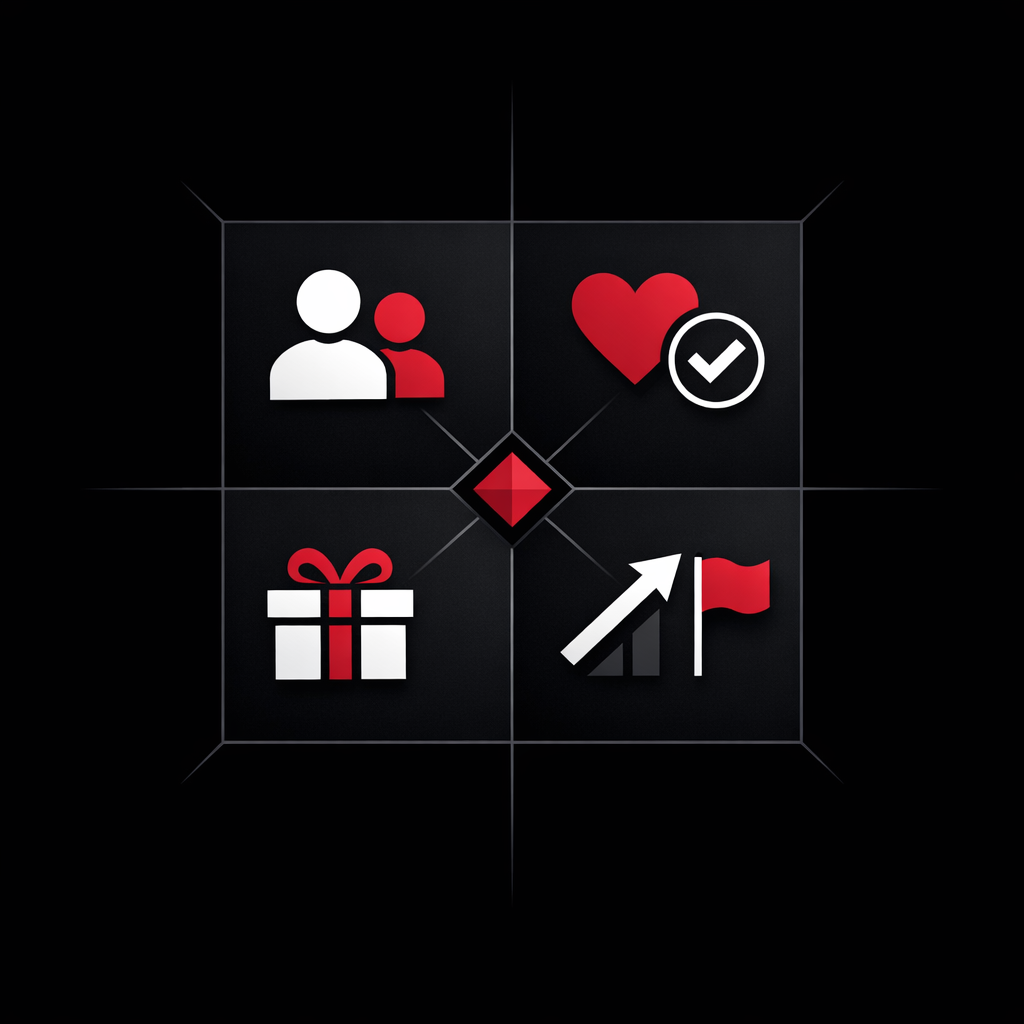
“A clear product vision aligns needs, value, and direction so teams build with purpose, focus, and better decisions.”
A Product Vision Board is a simple strategic framework used to clarify why a product should exist, who it serves, what problem it solves, and how it creates value. It helps transform an idea into a shared direction that guides discovery, prioritization, and execution. Instead of starting with features, it starts with purpose, audience, needs, and outcomes.
This approach is especially useful when teams need alignment across product, business, design, delivery, and stakeholders. It creates a common understanding before roadmaps become crowded with assumptions and before solutions are defined too early.
What it stands for
A Product Vision Board structures product thinking around a few essential questions:
- Target group: who the product is for, including the main audience or customer segments.
- Needs: what these people are trying to achieve, what difficulties they face, or what expectations are currently unmet.
- Product: the solution concept that addresses those needs in a meaningful way.
- Business goals: the value created for the organization, such as growth, efficiency, market differentiation, retention, or strategic positioning.
Together, these dimensions ensure that product direction is not defined only by internal ideas or technical possibilities. The board encourages teams to understand people first, identify relevant problems, and connect the solution to measurable business value.
Why it matters
Many products struggle not because teams cannot deliver, but because they deliver without enough clarity on who they are helping and why the solution matters. A Product Vision Board helps reduce that risk by making assumptions visible early.
It supports better decisions by helping teams:
- align stakeholders around a shared product purpose,
- focus on real user problems rather than feature requests alone,
- evaluate ideas against clear value and strategic intent,
- build stronger coherence between discovery and delivery,
- avoid waste caused by unclear scope or conflicting expectations.
Core elements in practice
1. Target group
The first step is to identify the people the product is meant to help. This can include customers, employees, partners, or any group interacting with the solution. A useful vision is specific enough to guide decisions. “Everyone” is rarely a productive answer.
2. Needs and problems
Once the target group is clear, the board captures what matters to them. This includes pains, goals, constraints, frustrations, or tasks they need to complete. The focus is not on what the organization wants to build first, but on what creates relevance and usefulness for the people involved.
3. Product idea
This part describes the product concept at a high level. It is not a detailed specification. It should explain how the solution addresses the identified need and what makes it meaningful. The intent is to frame the value proposition, not to freeze implementation too soon.
4. Business goals
A product must also support organizational outcomes. This section clarifies what success means from a business perspective. Examples include entering a new market, increasing conversion, improving collaboration, reducing operational cost, or strengthening customer loyalty.
Benefits for teams and organizations
A Product Vision Board is valuable because it is concise, visual, and discussion-oriented. It can be used in workshops, product discovery sessions, portfolio discussions, and strategy reviews. It also helps create consistency between long-term intent and short-term delivery choices.
Common benefits include:
- Strategic alignment: everyone understands the direction and rationale behind the product.
- Shared language: cross-functional teams can discuss value, audience, and goals more clearly.
- Better prioritization: initiatives can be compared against actual needs and outcomes.
- Reduced ambiguity: assumptions are surfaced before investments become too large.
- Improved communication: stakeholders can quickly understand the product’s intent.
How to use it effectively
The board is most effective when it is treated as a living strategic artifact rather than a one-time exercise. Teams should revisit it as they learn more from research, market feedback, usage data, and delivery constraints.
Good practices include:
- use evidence from interviews, observation, analytics, and market insight,
- keep the wording simple and specific,
- challenge assumptions openly,
- connect the board to roadmap and outcome tracking,
- update it when the product context changes.
Common mistakes to avoid
- Starting with features: listing functions before clarifying problems weakens strategic focus.
- Being too generic: vague audience and vague needs lead to vague decisions.
- Ignoring business value: a relevant solution still needs organizational viability.
- Treating it as final: product understanding evolves and the board should evolve with it.
- Creating it in isolation: stronger results come from collaborative input across disciplines.
Where it fits in product management
A Product Vision Board sits upstream of detailed planning. It helps shape product direction before epics, backlogs, and delivery milestones are defined. It complements methods such as product discovery, opportunity assessment, roadmap planning, and value proposition work.
For product managers, it is a practical tool to bridge strategy and execution. For leadership, it provides a compact way to evaluate whether a product idea is grounded in clear needs and meaningful outcomes. For teams, it creates a stronger sense of purpose behind day-to-day work.
Conclusion
A Product Vision Board is a powerful way to bring clarity to product intent. By focusing on audience, needs, solution, and business goals, it helps teams create products that are useful, coherent, and strategically relevant. Its strength lies in simplicity: it keeps attention on what matters most before effort is spent on building the wrong thing.