
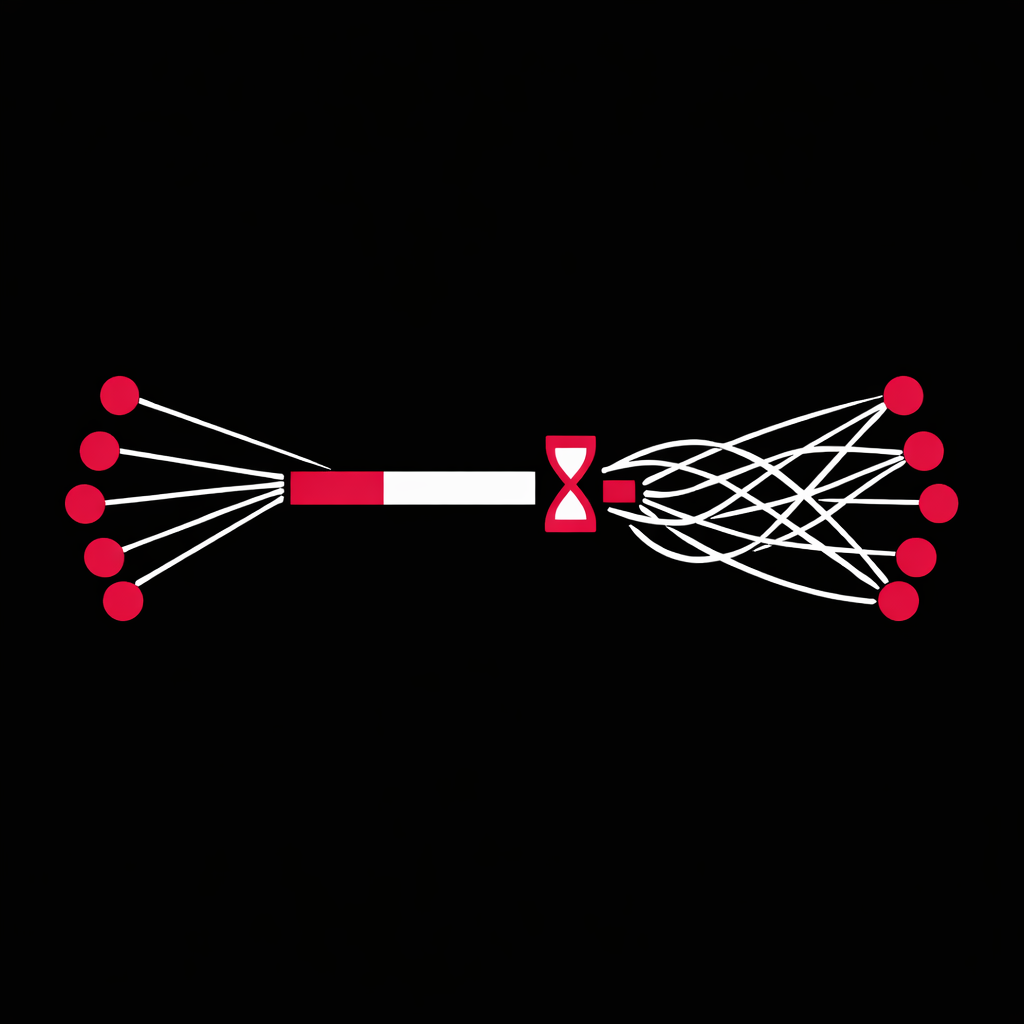
“Adding people to a late project often makes it later: coordination grows faster than output when teams expand.”
Brook’s Law is a practical management principle stating that adding manpower to a late software project makes it later. It highlights a recurring pattern in project delivery: when a team is already under pressure, bringing in new people rarely creates instant acceleration. Instead, the effort needed to onboard them, align work, and increase communication often slows progress further.
This idea is especially relevant in software, digital transformation, product delivery, and complex collaborative environments where work is tightly connected. It remains one of the most cited principles in project management because it explains why apparently logical decisions can produce the opposite result.
What it stands for
Brook’s Law comes from Fred Brooks, who described this principle in the context of software engineering and large-scale project execution. The law expresses a simple but powerful reality: time is not always compressible by adding more people.
The underlying reason is that knowledge work is not purely divisible. In many projects, especially those involving design, development, testing, governance, and stakeholder alignment, people depend on each other. New contributors need access, context, explanations, quality standards, architectural understanding, and coordination with existing team members. That support consumes time from the people who are already doing the work.
Why adding people can slow a project down
- Onboarding effort increases: new team members need training, context, tools, and guidance.
- Communication paths multiply: more people create more interactions, meetings, handoffs, and misunderstandings.
- Work is not always divisible: some tasks depend on prior decisions, shared architecture, or specialist expertise.
- Existing contributors are interrupted: senior team members spend time supporting newcomers instead of advancing delivery.
- Integration risk rises: more parallel contributions can create more defects, inconsistencies, and rework.
In short, the problem is not the people themselves. The problem is the timing, structure, and nature of the work.
Where this principle applies
Although strongly associated with software engineering, Brook’s Law also applies in broader business and organizational settings:
- Project management: when a delayed project receives extra resources too late in the lifecycle.
- Change management: when more actors are introduced without sufficient alignment on process and objectives.
- Product management: when urgent feature pressure leads to rapid staffing without clear ownership.
- Collaboration: when teams grow faster than shared understanding and decision mechanisms.
- Business management: when leaders assume all capacity is interchangeable.
The principle is especially visible in environments where tacit knowledge matters. If key information is undocumented or held by a few experts, scaling the team quickly can become inefficient.
Common misunderstanding
Brook’s Law does not mean that adding people is always a bad idea. It means that adding people to a late project can worsen delays when the work is highly interdependent and the ramp-up cost is significant.
Additional staffing can still help when:
- work can be split into largely independent streams,
- onboarding is fast and well supported,
- standards and documentation are mature,
- leadership clarifies ownership and decision rights,
- the project still has enough time for new contributors to become effective.
This distinction is important. The principle is not a rejection of scaling, but a warning against simplistic recovery plans.
Practical implications for managers
When delivery is slipping, the first instinct is often to increase headcount. A better response is to first diagnose the real constraint:
- Is the issue lack of capacity, or unclear priorities?
- Are dependencies blocking progress?
- Is decision-making too slow?
- Is quality rework consuming delivery time?
- Is knowledge concentrated in a few individuals?
Before adding people, managers should reduce friction by simplifying scope, protecting focus time, clarifying responsibilities, and improving communication. In many cases, removing obstacles delivers more than expanding the team.
How to use the idea effectively
To apply this principle in a constructive way:
- Staff early: add people before the project reaches crisis mode.
- Modularize work: structure tasks so teams can contribute with fewer dependencies.
- Improve documentation: reduce reliance on verbal transmission of critical knowledge.
- Limit coordination overhead: keep roles, interfaces, and decision processes clear.
- Manage scope actively: reducing commitments can be more effective than adding resources.
This makes the principle useful not only as a warning, but also as a guide for designing healthier delivery systems.
Why it still matters
Modern organizations use agile methods, digital collaboration tools, cloud platforms, and distributed teams, yet Brook’s Law remains highly relevant. Technology can improve communication speed, but it does not remove the cognitive cost of shared understanding, synchronization, and integration.
Whenever leaders treat complex knowledge work as if it were simple factory output, they risk making the same mistake this principle describes. Sustainable execution depends not only on how many people are involved, but on how effectively work is structured, shared, and coordinated.