
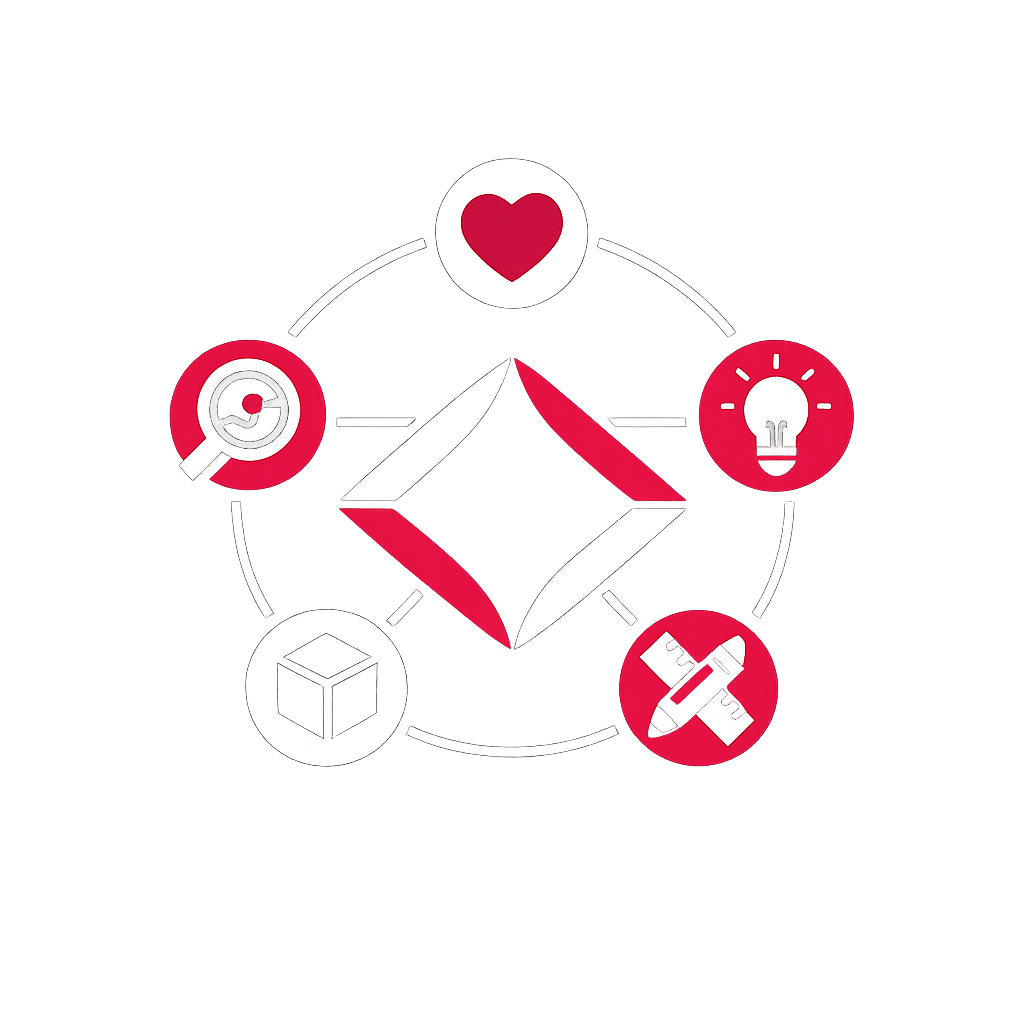
“Solve the right problem first: start with people, test quickly, learn fast, and improve with each iteration.”
This approach is a human-centered way to solve complex problems, reduce uncertainty, and create solutions that are both useful and feasible. It is widely used in product development, service improvement, project work, innovation initiatives, change programs, and business transformation.
Rather than starting with assumptions or jumping directly to implementation, it encourages teams to understand people, challenge initial ideas, explore options, and validate solutions early. The goal is not only to produce a better outcome, but also to reduce waste, improve adoption, and align solutions with real needs.
The method is often presented as a sequence of five steps. In practice, these steps are iterative. Teams may move back and forth between them as they learn more.
1. Empathize
The first step focuses on understanding the people affected by the problem. This means observing behaviors, listening carefully, asking open questions, and identifying needs, frustrations, motivations, and constraints.
Typical activities include:
- Interviews with users, customers, employees, or stakeholders
- Field observation and shadowing
- Journey mapping
- Review of feedback, incidents, complaints, or support requests
This stage helps teams avoid designing from internal assumptions alone. It brings reality into the process and reveals what matters most to the people the solution should serve.
2. Define
Once enough insight has been collected, the next step is to frame the problem clearly. This is where scattered observations become a focused challenge statement.
A strong definition should:
- Be centered on people and their needs
- Describe the core problem, not only symptoms
- Be specific enough to guide action
- Remain open enough to encourage creative solutions
For example, instead of saying “the process is inefficient,” a better framing may be “new employees struggle to complete onboarding because key information is spread across too many tools.”
Good problem framing is critical. If a team defines the wrong problem, even an excellent solution can fail.
3. Ideate
This step is about generating multiple ideas before selecting one. The objective is to widen the range of possible solutions, challenge conventional thinking, and explore alternatives without judging too early.
Useful practices include:
- Brainstorming
- Workshops with cross-functional teams
- Scenario exploration
- Analogy-based thinking
- Prioritization matrices
Diversity is especially valuable here. Different perspectives from business, technology, operations, support, marketing, or end users often lead to stronger and more practical ideas.
The key is to separate idea generation from evaluation. First create options, then assess them.
4. Prototype
Instead of investing heavily in a complete solution too early, this step encourages building a simplified version that can be explored quickly. A prototype can be a sketch, workflow, mockup, clickable screen, service blueprint, draft communication, or even a role-play.
The purpose is to make ideas tangible so that people can react to them. This helps teams answer questions such as:
- Does the concept make sense?
- Is it usable?
- What assumptions are most risky?
- What needs to be improved before scaling?
Fast and low-cost prototypes reduce risk. They make it easier to learn early, before time and budget are committed to full delivery.
5. Test
The final step is to gather feedback from real users or stakeholders by putting the prototype in front of them and observing how they respond. The objective is not to prove that the initial idea was right, but to learn what works, what does not, and what should change.
Testing often includes:
- User feedback sessions
- Pilot releases
- Usability testing
- Measurement of adoption, errors, satisfaction, or outcomes
Insights from testing frequently lead back to earlier steps. A team may refine the problem definition, generate new ideas, or create a better prototype. This learning loop is one of the strengths of the method.
Why this approach matters
Organizations often face unclear requirements, resistance to change, limited adoption, and solutions that technically work but fail in real life. This structured yet flexible approach helps address those risks by putting human needs, experimentation, and learning at the center of problem solving.
It is particularly valuable when:
- The problem is complex or poorly defined
- User adoption is critical
- Multiple stakeholders have different expectations
- Innovation is needed but risk must be controlled
- A service, process, or product needs continuous improvement
Common benefits
- Better understanding of real needs
- Stronger alignment between business goals and user expectations
- Faster learning through experimentation
- Reduced waste by validating early
- Improved collaboration across teams
- Greater chance of adoption and long-term value
Limits to keep in mind
This method is powerful, but it is not a shortcut. It still requires discipline, stakeholder engagement, and the ability to act on what is learned. Poor research, weak testing, or lack of decision-making support can reduce its impact.
It also works best when combined with delivery, governance, and execution capabilities. Understanding a problem well is essential, but implementation quality remains just as important.
Practical takeaway
When teams rush to solutions, they often solve the wrong problem. A better path is to understand people first, define the challenge clearly, explore multiple ideas, test quickly, and improve continuously. This creates better outcomes for users and stronger results for the business.